

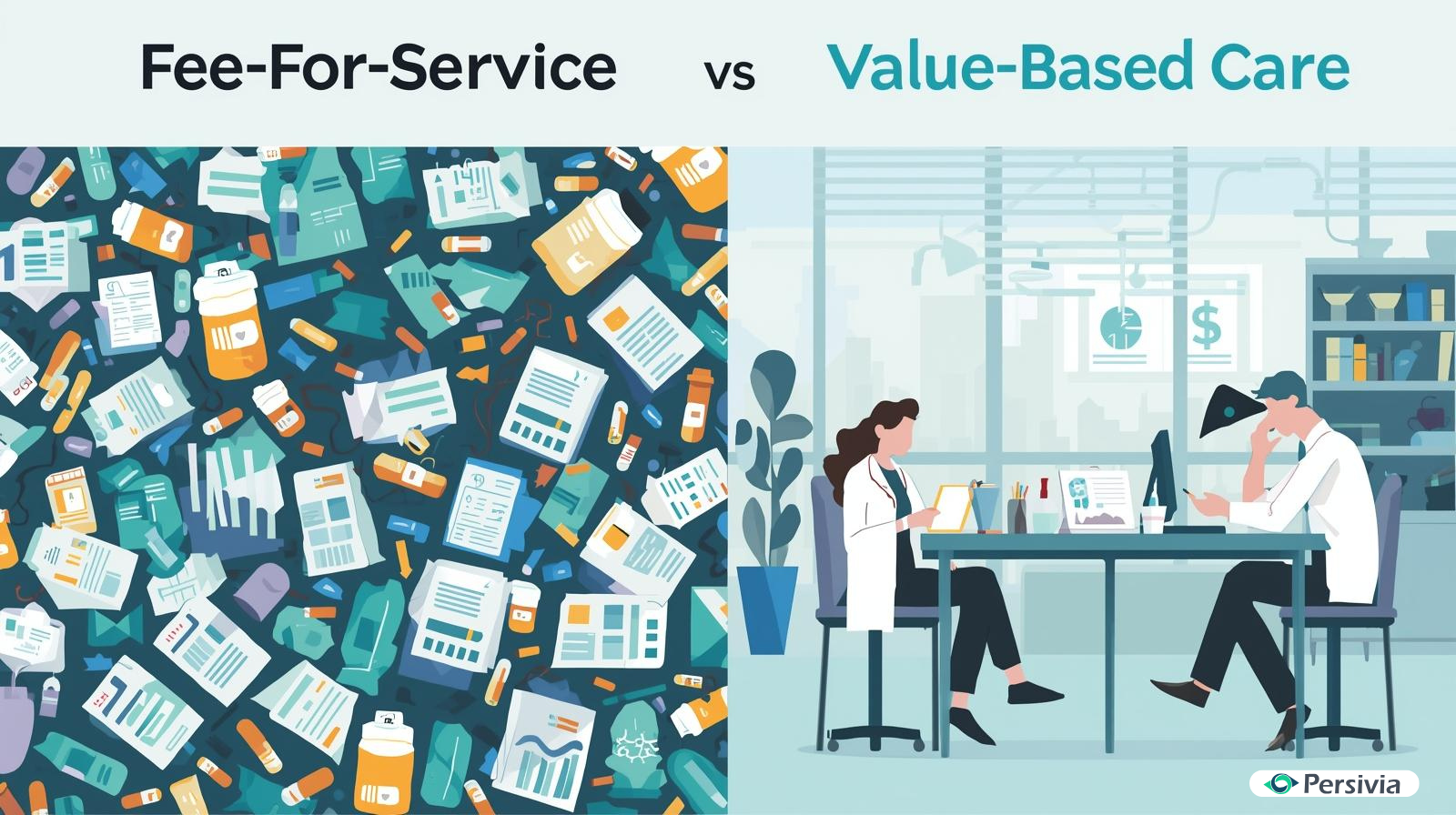
Healthcare payment models influence how providers deliver care, manage resources, and prioritize patient outcomes. There are two prevailing strategies: Fee for Service vs Value-based Care, which are based on completely different principles. Fee-for-service reimburses providers for each test, procedure, and visit, regardless of the patient outcome. Value-based care is based on incentives that aim at quality results, improvement of patient health, and efficiency, rather than volume of services.
Leaders who operate within this terrain are confronted with choices that have an impact on the clinical operations, financial sustainability, and patient satisfaction. Workflow, technology, and organizational priorities change when shifting from volume-based to outcome-based payment. Understanding both models helps leaders make stronger decisions for long-term clinical and financial stability.
What is Fee-for-Service?
Fee-for-service remains one of the most widely used healthcare payment models in which the healthcare provider makes money on a case-by-case basis. The payment system is simple, and the more services provided, the more the revenue. Every doctor visit, lab test, scan, and procedure attracts a distinct charge to be billed.
How Fee-for-Service Works
Services on a predetermined rate are given to providers according to billing codes. Each service carries its own billing code and rate, whether it is an office visit, an X-ray, or a surgical procedure. Insurance companies or patients pay these charges after service delivery.
In today’s environment, this model still has a few practical advantages.
- Predictable revenue streams based on patient volume
- Simple accounting and billing processes
- Provider autonomy in treatment decisions
- Easy-to-understand payment structure
The incentive structure is, however, problematic. The more services that providers offer, the more they will make profits, whether their services are enhancing the health of the patients. This model can unintentionally encourage more testing even when it does not meaningfully improve outcomes.
Limitations of Traditional Payment
The fee-for-service model often increases healthcare spending because it can drive overuse of services. Providers are under financial strain to ensure that they see as many patients as possible and order as many procedures as possible. Preventive care generates minimal revenue compared to treating illnesses after they develop.
Common issues include:
- Fragmented care with poor coordination
- Duplicate testing across specialists
- Conflicting treatment plans
- Reactive medicine prioritized over prevention
- Rising costs without quality improvements
What is Value-Based Care?
Value-based care pays providers based on patient outcomes instead of the volume of services delivered. Providers are also rewarded based on keeping patients healthy, effective coordination of care, and attainment of quality standards. Compensation is tied to measurable outcomes such as lower readmissions, better chronic disease control, patient experience scores, and meeting cost benchmarks.
Core Components of Value-Based Models
The difference between value-based care vs fee-for-service focuses on the incentive for payment. Value-based contracts set certain quality standards that should be achieved by the providers. These are completion rates of preventive care, disease management effectiveness, and improvement of patient health.
Key elements include:
- Payment tied directly to patient outcomes
- Emphasis on preventive care delivery
- Coordination among multiple providers and specialists
- Continuous quality measurement and reporting
- Shared financial risk and rewards
Digital health platforms support value-based care by tracking quality metrics, identifying care gaps, and coordinating teams across settings. Technology consolidates patient data in a variety of environments, detects care gaps, and tracks quality improvement efforts.
Why Value-Based Care Drives Better Results
Value-based models align financial incentives with patient health outcomes. Preventive care becomes financially meaningful because avoiding complications supports quality scores and shared savings. The care teams are not concerned with the volume of treatment, but with the wellness of the long-term.
Benefits include:
- Reduced hospital readmissions
- Better chronic disease management
- Improved patient satisfaction scores
- Lower overall healthcare costs
- Enhanced care coordination across providers
Persivia CareSpace® is an example of a platform that supports population health management. Combined platforms assist in monitoring quality outcomes, managing care groups, and detecting patients who require an intervention before the conditions deteriorate.
Fee for Service Vs Value-based Care: Key Differences
The radically different nature of these payment models has an impact on all stages of healthcare delivery. Awareness of such differences will enable the leaders to assess the most appropriate approach to use in their organization.
| Aspect | Fee-for-Service | Value-Based Care |
| Payment basis | Each service performed | Patient outcomes and quality |
| Primary focus | Service volume | Care quality |
| Provider incentive | More procedures = more revenue | Better outcomes = higher rewards |
| Patient satisfaction | Not linked to payment | Directly affects reimbursement |
| Care coordination | Minimal financial incentive | Required for success |
| Preventive care | Limited revenue potential | Central to the payment model |
| Cost trajectory | Tends to increase | Designed to decrease |
| Technology needs | Basic billing systems | Advanced analytics platforms |
Financial Implications
Fee-for-service generates volume-based revenue, which organizations are able to predict and scale. The addition of providers or the expansion of hours has a direct revenue impact. Value-based care brings in variability; revenue is based on the ability to meet benchmarks and to control the patient population.
Financial considerations:
- Fee-for-service offers immediate payment for services
- Value-based care delays returns until quality metrics are met
Many organizations adopt mixed approaches, maintaining some fee-for-service contracts while expanding value-based arrangements. This strategy provides financial stability during transition periods.
What Healthcare Leaders Must Consider
Leaders who have to decide on the models of payment should consider various factors within their organizations. There is no common solution; the correct decision will be associated with abilities, market factors, and strategic objectives.
Organizational Readiness and Infrastructure
The value-based care needs advanced technology, which is unavailable to many organizations. Leaders have to examine the capacity of existing systems to measure quality indicators, organize the care team, and analyze the health of the population.
Technology requirements:
- Electronic health records with interoperability
- Population health management platforms
- Care coordination software
- Real-time analytics and reporting tools
- Patient engagement systems
This infrastructure requires a heavy investment in platforms, training, and the redesign of workflow. Organisations that have mature systems are easy to transition compared to those that were using fragmented technology.
Patient Population Characteristics
The effectiveness of each payment model depends heavily on patient demographics and risk profiles. Value-based approaches are most effective with high-risk populations who experience chronic diseases. Collaborative care management of diabetic diseases, heart diseases, and other ailments averts the costly complications.
Consider these factors:
- Age distribution and chronic disease prevalence
- Geographic spread and access to care
- Socioeconomic factors affecting health
- Cultural considerations in care delivery
Younger, healthier populations generate different dynamics. Preventive care offers long-term value, but immediate financial returns remain limited under value-based contracts.
Financial Sustainability During Transition
Moving from Fee-for-service to Value-based care creates revenue uncertainty. Organizations must maintain operations while building new capabilities and waiting for value-based returns.
Questions to address:
- How long can the organization sustain reduced revenue?
- What percentage of contracts can shift to value-based models safely?
- Where will funding come from for technology and staffing investments?
- What financial reserves are available for transition periods?
This transition requires capital or external funding to bridge gaps between legacy and value-based payment systems.
Regulatory Environment and Market Pressure
Government programs increasingly mandate value-based participation. Medicare implements quality bonuses and penalties tied to outcomes. Medicaid programs in many states require value-based arrangements.
Market forces include:
- Payer requirements for quality reporting
- State and federal mandates
- Commercial insurer value-based contracts
- Competitive pressure from other providers
Leaders must understand their payer mix and regulatory requirements. Some markets move faster toward value-based care than others.
Workforce and Cultural Change
Value-based care demands different skills and mindsets. Clinical staff must embrace data-driven decision-making. Administrative teams need training in quality improvement and population health management.
Change management priorities:
- Staff training on new workflows and technology
- Incentive structures aligned with outcomes
- Clear communication about transition goals
- Leadership commitment at all organizational levels
The process of cultural change is not quick. Companies that have quality-oriented cultures are more adaptive than those that are based on volume practices.
Making Strategic Choices
The choice between payment models is not binary. In the majority of successful organizations, a hybrid practice with a capture of the advantages of both structures is applied. They hold on to fee-for-service revenues to remain stable and build value-driven capabilities to be sustainable in the future.
When Fee-for-Service Makes Sense
Some organizations thrive under traditional payment structures. Specialty practices providing unique procedures or surgeries may find fee-for-service more profitable.
Fee-for-service works best for:
- Specialty or procedural-focused practices
- Limited patient continuity relationships
- Unique services with strong demand
- Markets with low value-based adoption
When Value-Based Care Offers Advantages
Primary care practices managing ongoing patient relationships benefit from value-based models. The ability to influence long-term health through prevention and coordination generates better financial returns than episodic visits.
Value-based care suits organizations with:
- Established primary care patient panels
- Advanced technology infrastructure
- Strong care coordination capabilities
- Quality improvement expertise and culture
Wrap Up
In a nutshell, choosing between fee-for-service and value-based care affects strategy, operations, and finances. Fee-for-service is predictable revenue, but may be used to encourage overutilization, whereas value-based care rewards but demands investment in technology and culture.
FAQs
- What is the main difference between fee-for-service and value-based care?
Fee-for-service pays providers for every individual service or procedure, regardless of results. Value-based care rewards improved patient outcomes, coordinated care, and cost efficiency. The key difference lies in payment being tied to volume vs. quality.
- Does value-based care lead to better outcomes?
Yes, value-based care often leads to better outcomes because it promotes prevention, coordinated treatment, and consistent monitoring. These factors reduce complications, improve chronic disease management, and enhance overall patient satisfaction and outcomes.
- What technology is required for value-based care success?
Value-based care relies on advanced analytics, population health platforms, and care coordination tools. These technologies help track outcomes, close care gaps, and manage at-risk populations effectively.
- How long does it take to transition to value-based care?
Transitions typically take two to five years. Organizations need time to implement technology, redesign workflows, train staff, and demonstrate measurable improvements before fully benefiting from value-based contracts.